
Recognize Instruments in Wichita County Deed Records
The Wichita County Register of Deeds accepts deeds, mortgages, oil and gas leases, powers of attorney, cemetery deeds, UCC material, and other qualified instruments for recording. Filings matter here. Not every recorded item transfers ownership.
| Deed Type | What It Does | Common Use |
|---|---|---|
| Warranty deed | Conveys the stated interest with deed warranties | Ordinary purchase transfers |
| Quitclaim deed | Conveys whatever interest the grantor has, if any | Interest cleanup or limited-warranty transfers |
| Executor or administrator deed | Conveys through authorized estate administration | Property passing through probate |
| Tax or sheriff's deed | Records a transfer following the applicable sale process | Tax or judicial proceedings |
| Cemetery deed | Documents the interest stated in the instrument | Burial-lot records handled by the recorder |
A mortgage only secures an obligation. An assignment shifts who holds an interest, and a release clears an encumbrance only as far as its text allows. None of these should be read as an ownership transfer just because it sits beside deeds in the record.
Wichita County's Deed Trail Is an Office Search
The county offers no official grantor-grantee portal, image service, or stated coverage year for online deed records. Public inspection happens at 206 South 4th Street in Leoti, Monday through Friday from 8 a.m. to noon and 1 to 5 p.m. A request can also begin by phone at 620-375-2733, by email at whcorod@wichitacounty.org, or by mail to P.O. Box 472, Leoti, KS 67861.
When you write, give the instrument type, both party names if known, the legal description, the parcel ID, and a date range. Ask which book and page or instrument number covers the filing, plus the current copy cost. The Register of Deeds page spells out the official route.
Open the Wichita County Register of Deeds page.
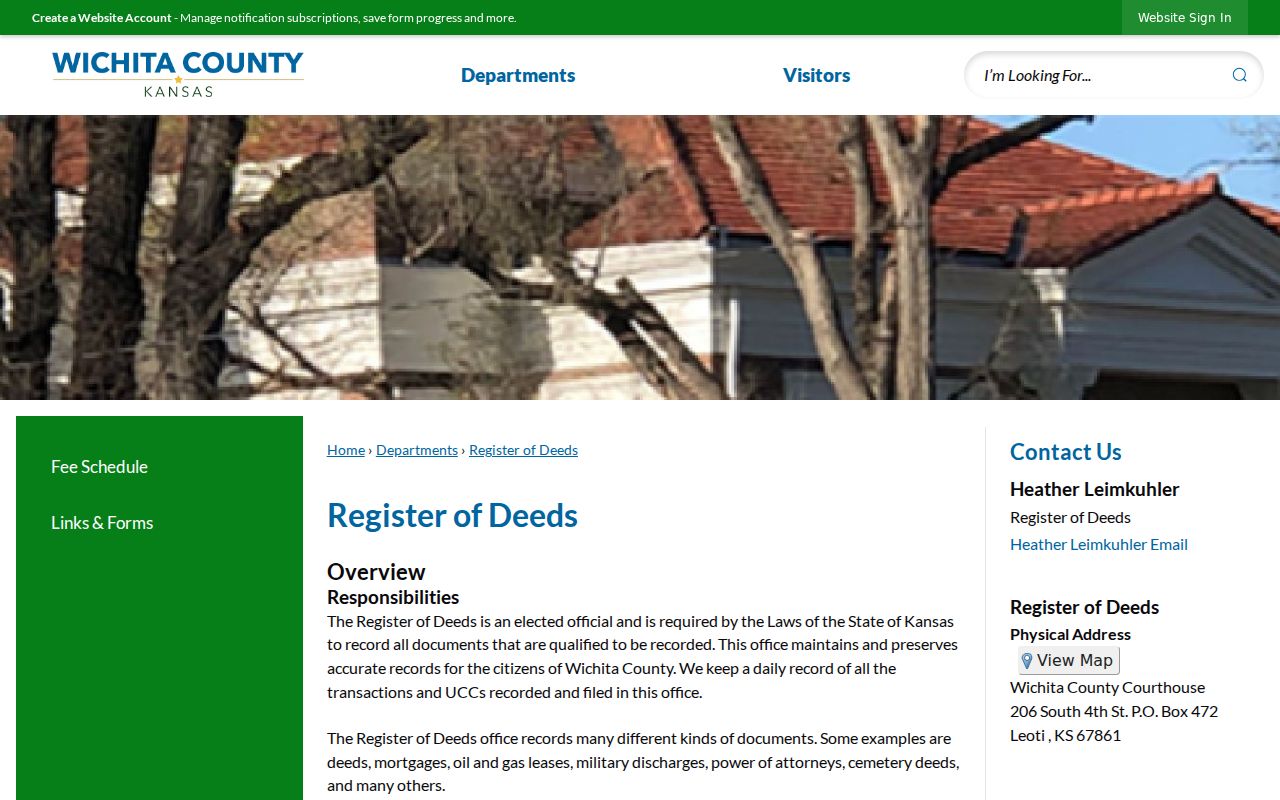
The image points searchers straight to the official custodian of Wichita County deed records rather than passing off a third-party index as county coverage.
Give the Recorder Fields That Match
| Request Field | Detail to Give | Reason |
|---|---|---|
| Party | Grantor and grantee names, including variants | Locates a name-index entry |
| Instrument | Deed, mortgage, release, lease, lien, UCC, or plat | Separates transfers from encumbrances |
| Land | Lot/block/addition or section-township-range | Tests whether a name hit concerns the right land |
| Time | Recording-date range | Limits staff searching |
| Reference | Book/page, instrument number, or parcel ID | Points to a particular filing |
These are documented request details, not invented fields from a missing electronic interface.
Follow Grantor and Grantee Names Forward
Begin with an instrument whose legal description matches the parcel you care about. That description is your anchor. From there, carry the receiving party forward through later years, watching for the moment they show up as the one transferring the land. People and entities appear in unrelated land records all the time. Verify every step against the legal description, and the chain you build will actually hold.
- Identify the land with the latest reliable legal description.
- Find a matching deed and record its parties, date, and reference.
- Search the grantee as a later grantor for a subsequent transfer.
- Compare descriptions and note corrections, splits, combinations, or vacations.
- Grantor
- The party conveying the stated interest.
- Grantee
- The party receiving that interest.
- Chain of title
- The ordered sequence of instruments tied to the same land.
- Book/page or instrument number
- A recorder reference for retrieving a filing.
Cowen's Addition Supplies an Exact Deed Clue
A 2024 foreclosure notice points to a specific property: Lot 2, Block 9, Cowen's Addition to the City of Leoti, parcel ID 01941, at 503 S 5th St. Treat it as a lead only. It is not a deed, and it proves nothing about who owns the property today. Its real value is the exact description, which you can repeat word for word to the Register of Deeds.
For a deeper trail, cross-check case WH-2023-CV-000005 in Kansas Courts CaseSearch. Needed filings then come from the local court. Any conveyance recorded after the litigation still has to be tracked down with the recorder.
Separate Encumbrances From Conveyances
Deed records sit among many other filings, and the county schedule makes that plain. It lists mortgages, assignments, releases, UCCs, fixture filings, liens, and lis pendens. None of those are conveyances. A mortgage does not transfer ownership to a buyer. A release speaks only to the interest it describes, and an assignment can change a beneficiary while the landowner stays exactly the same.
Fees are listed per request type. A written information request per debtor name runs $15. UCC originals, amendments, continuations, assignments, releases, and terminations are also listed at $15. Mortgage assignment and release charges differ by page instead. Confirm current charges before you order or file anything.
Reach Back Before Modern Parcel References
The Kansas Historical Society land-record guide pulls together several record types. These include tract books, federal patents, railroad grants, original surveys, county deeds, and plat atlases. Tract books record the legal description, grantee, acreage, price, date, and governing law. They are not indexed by owner name. So bring a section, township, and range whenever a deed predates a street address or subdivision label. Wichita County was established in 1873. It was organized in 1886, with Leoti serving as the temporary county seat. Those dates anchor the county's administrative history without pointing to any particular first deed book. For older conveyances, pairing the tract-book entry with the county's deed records helps. Together they give the clearest chain of ownership.
Note: No courthouse fire or wholesale deed loss appears in any official source, so neither should be claimed.
Order a Wichita County Deed From the Custodian
Once the instrument is identified, request a plain or certified copy. Ask for an estimate first. The county fee schedule prices copies at $1 per page. Certification adds $7.50. Recording an ordinary deed, mortgage, or instrument costs $21 for the first page. Each later page costs $17. That filing charge is separate from copy pricing. Keep in mind that Sales Validation Questionnaires and military discharges are closed to public inspection. A completed questionnaire offers no workaround for restrictions on sales information.
Recorded, not guaranteed. Wichita County deed records show accepted filings, but do not resolve every unrecorded interest, defect, or competing claim and are not a title opinion.
Use Plats and Newspapers as Finding Aids
A plat atlas maps how land is arranged and named. A deed records the conveyance itself. For an addition such as Cowen's, ask the recorder for both the plat and the deed references. The county fee schedule lists town plats at $32 per page. Any current figure should be confirmed before ordering.
The KSHS newspaper database accepts city, title, county, and date clues. Search an addition name, a sheriff sale, a tax sale, an estate, or a deed. That can surface parties and dates. A notice is only a finding aid. It never substitutes for the recorded instrument in the deed records.
Historic place names sharpen that search. Bonasa became Leoti in 1887. Coronado, Lydia or Kearny, Carwood, Marienthal, and Selkirk also appear in Wichita County postal history. Pair an old place name with the modern legal description. Do not assume an unfamiliar locality points to a different county.
Check Court Files Against Later Recordings
A deed search has one blind spot: disputes that are still working through the courts. A court search has the opposite weakness. It may stop before the final instrument ever reaches the deed records. The Wichita County District Court sits in the 25th Judicial District. Requests can go in by phone, fax, mail, or in person. The courthouse law library also offers public computers for research. Copies run $0.25, and the court's stated workflow allows three business days for a response.
Court files matter for many kinds of disputes. These include foreclosures, quiet title actions, probate, partition suits, lien enforcement, and boundary or easement fights. Pull the full legal description from a filing first. Then hold it against whatever the recorder logged afterward. That could be a deed, a release, or a lis pendens. CaseSearch carries a warning worth heeding. It is not the official court record. Some older documents or case types simply do not appear. Finding a plaintiff, a defendant, or a sale notice in a docket does not settle who the owner of record is. Only the recorded instrument does that.
Recording fees tell you cost, not content. The recorder's schedule prices a lis pendens at $5. A material or service lien runs $17. Federal tax-lien notices or releases cost $32. Those figures say nothing about whether any such filing touches a particular parcel number.