
Move a Wichita County Property Search Across Offices
The right first step is a request to the Wichita County Appraiser for a Property Record Card, or PRC. The county publishes no self-service assessor interface. So an address or owner name is something to give the office, not a promise of an instant web result. Ask for the parcel's ownership field. Also request the legal description and building details. Acreage, square footage, and any parcel identifier the office can supply all help the next lookup.
- Give the Appraiser the situs address and city, plus the approximate owner if known.
- Ask for the PRC, the ownership field, legal description, parcel ID, and date of the roll being supplied.
- Carry the exact owner name and legal description to the Register of Deeds to identify recorded instruments.
- Ask the Treasurer about the matching tax account, year, status, and any correction history that is public.
- Use Kansas CaseSearch for related foreclosure, lien, quiet-title, partition, or probate litigation, then verify documents with the local clerk.
This sequence keeps assessment, title, tax, and litigation records in their proper roles. One office result becomes the search key for the next.
Build the Appraiser Request Before Calling
The county's published pages support an office-request workflow rather than a self-service Wichita County property search. A strong request names the record. Matching details let staff single out the parcel. Give the situs address and parcel ID. Add the owner name from any notice, the lot, block, and addition or section, township, and range, and the roll date you need.
| Clue to Supply | County Field It Matches | Why It Helps |
|---|---|---|
| Street address | PRC situs address | Locates the physical property, not the tax-mail destination |
| Owner name | PRC ownership | Disambiguates an address and supports a recorder name search |
| Parcel ID | County number or parcel | Provides a compact identifier, although its format is not published |
| Legal description | Lot/block/addition or section-township-range | Connects assessment, deed, and plat material |
| Requested year | Assessment roll date | Prevents a current record from being mistaken for an older one |
Keep ownership and valuation requests separate from comparable-sales requests. The Appraiser restricts sales information to certified appraisers.
Owner-Name Lookup Means an Office Query
Owner-name lookup in Wichita County means an office query. The Appraiser can answer questions such as ownership by landowners with 10 acres or more. But the office publishes no owner-name search form. Pair a common name with a second identifier like acreage, a situs address, or a parcel number. A legal description works too. For a company, use the name exactly as the PRC shows it, then check the Kansas Secretary of State Business Entity Search for entity context.
Search vocabulary
Situs address: the physical location of the property. Tax mailing address: where the tax statement goes. Owner of record: the ownership entry on the county roll the record references. Parcel ID: a county identifier, sometimes called an APN elsewhere, whose Wichita County format the county does not officially explain.
A different mailing address is not proof of an error. Owners may receive mail elsewhere, and a protected or substitute address can appear for lawful reasons.
Read a Wichita County Property Record Card
A PRC is the best first inventory in a property search. The county confirms it holds land, ownership, and improvement details. It is not a deed-index result. The official page promises no sale price and no complete transfer history.
| Ownership | Name or names carried on the requested roll |
|---|---|
| Land description | The parcel's legal land description |
| Area | Acres or square feet, depending on the property |
| Building information | Recorded characteristics of improvements |
| Situs and mailing clues | Physical location and, where released, a distinct statement destination |
| Parcel reference | An identifier to repeat in tax, deed, and mapping requests |
The Appraiser page states plainly that the office provides no property-line information and does no abstract work. So the PRC is a record inventory. It is no survey or title opinion.
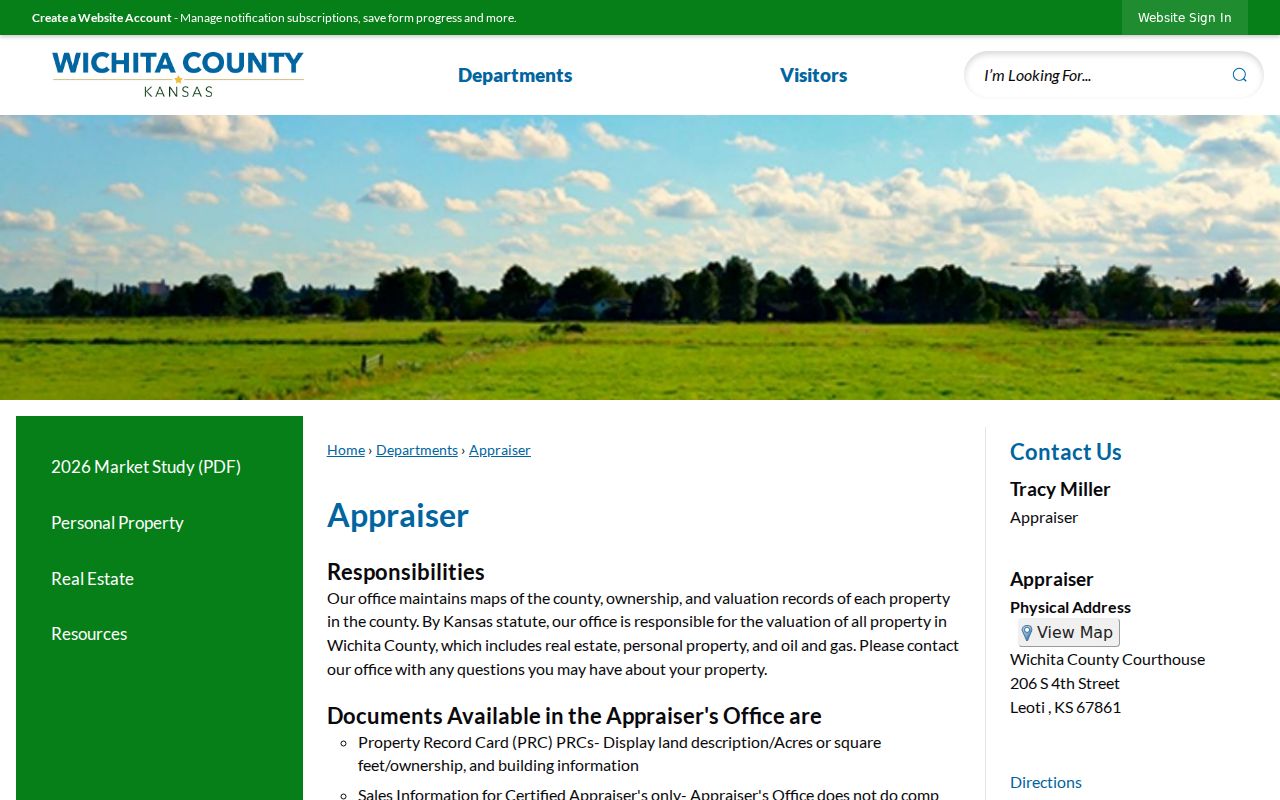
The office page explains why a precise property record card request matters here, since the county provides no assumed online search screen for property records.
Separate the Situs From the Mailing Address
Wichita County paperwork separates the property or situs address from the tax-statement name and mailing address. That distinction prevents a common mistake. Searchers often treat the place a bill is delivered as the parcel's physical location. Label each address when you request a record.
For Leoti property, a building permit adds a cross-check. The permit asks for the property location plus a legal description by block, lot, and addition. It also requires a plot plan with streets, dimensions, utilities, and a north arrow. The permit can reconcile building history with the PRC. Locating property lines stays the applicant's responsibility.
Note: ZIP codes are delivery geographies, not legal parcel boundaries or definitive city-limit maps.
Use Cowen's Addition as a Cross-Office Test
A 2024 foreclosure notice offers a concrete example. It lists parcel ID 01941, 503 S 5th St, Lot 2, Block 9, Cowen's Addition to the City of Leoti. One property appears here three ways: a street address, a parcel identifier, and a lot-block-addition description. That makes it a useful model. It is not evidence of today's owner or current case status.
A careful search would ask the Appraiser for a PRC using all three clues. It would give the Register of Deeds the legal description and a date range. Case number WH-2023-CV-000005 can go into Kansas Courts CaseSearch. CaseSearch says it is not the official court record. Confirm any docket result with the Wichita County District Court.
Choose Address, Owner, or Parcel Clues
Each search key solves a different matching problem. In Wichita County, address, owner, and parcel clues fit a staff-request, cross-office workflow. No county search screen covers them.
| Search Key | Best For | Where It Works | Watch Out |
|---|---|---|---|
| Address | One known property | Appraiser request; Leoti permit files | Historic place names and mailing-address confusion |
| Owner name | Locating a named holder | Appraiser office; Register of Deeds inspection | Entities, estates, spelling variants, and common names |
| Parcel ID | Repeating an exact county clue | PRC, tax, and deed requests | Only one sample was verified; no format rule is published |
| Legal description | Historic and title continuity | PRC, deeds, plats, tract books | May shift from city lot/block to section-township-range |
Not a title search. A Wichita County property search gathers public clues, but it does not establish clear title, resolve competing interests, or replace professional title work.
When the Web Search Is Missing
Wichita County publishes no online deed index, tax query, assessor search, or public GIS viewer. That gap does not mean the property records are missing. The Register of Deeds opens its deed records for public inspection during regular business hours. The Appraiser keeps property record cards on hand. Both offices sit at 206 South 4th Street in Leoti.
- Appraiser: call 620-375-4242 or visit Monday through Friday, 8 a.m. to noon and 1 to 5 p.m.
- Register of Deeds: call 620-375-2733, email whcorod@wichitacounty.org, mail P.O. Box 472, Leoti, KS 67861, or inspect records during the same split weekday hours.
- Treasurer: call 620-375-2715 or mail P.O. Box 488 for tax-year and bill-status questions.
- KORA request: send a specific request by mail, email, or fax through the county open-records process.
County guidance sets a three-business-day window for answering most open-records requests. Fees for staff time or copies may apply. Kansas law also keeps the door wide: a written request works. No particular form is required. If a request is delayed or denied, the county must explain that decision in writing.
Search Old Addresses Under Historic Names
A Wichita County property search can stall. The only clue may be a place name that no longer exists. Postal history explains why. The Kansas Historical Society records that Bonasa became Leoti in 1887. Coronado, Lydia or Kearny, Carwood, Marienthal, and Selkirk all appear in the county's post-office past as well.
When you write to an archive about an old parcel, pair the vanished name with the current legal description. You can do the same with the recorder. The Kansas Historical Society land-record guide is a strong starting point. It points researchers to tract books, original surveys, county plats, and federal patent records. Remember that tract books run by section, township, and range, not by owner of record. A later legal description may need converting. Then you can work backward through the property records.
Check Litigation Without Overreading It
CaseSearch asks for a court, a search type, a search term, a case type, a birth date, and a filing-date range, plus a human-verification step. Run a party name or a case number if you have one. From there, jot down the docket clues. Ask the 25th Judicial District clerk for the exact filing. Property disputes often show up under foreclosure, quiet title, partition, lien, lis pendens, tax, or probate labels, though you should use the portal's current case choices rather than assuming a category exists.
The local court takes requests by phone, in person, in writing, or by fax. Public computers sit in the courthouse law library. Copies are listed at $0.25, with local policy describing a three-business-day response. One caution belongs here. A party name in a lawsuit proves nothing by itself about a judgment, a completed sale, or current title. Treat litigation findings as leads. Confirm the rest against the deed records.