
Start a Wichita County Records Search
Wichita County keeps no portal that searches deeds, assessment cards, tax accounts, and maps together. So start from the record in hand. A street address points to the Appraiser. That office can produce a Property Record Card, or PRC. An owner name or legal description points to the Register of Deeds. There you find its recorded instruments. A tax statement belongs with the Treasurer. A foreclosure or quiet-title clue belongs with the District Court. Each source describes a different piece of the property.
Ask for a specific parcel and assessment year whenever you can. Keep the situs address separate from an owner's mailing address. Copy lot, block, addition, section, township, range, book and page exactly. Write them as the custodian gives them. Those fields turn one office's result into the next office's search key. A Wichita County property records search is evidence gathering. It is not a title opinion or boundary survey.
- Give the Appraiser the situs address and request the PRC's public ownership, land-description, acreage or square-foot, value, and building fields.
- Carry the legal description and parcel ID to the Register of Deeds and request the latest deed plus relevant mortgages, releases, liens, or plats.
- Ask the Treasurer for the parcel's tax status and the correct tax-year statement.
- Request an assessment map or recorded plat, while treating neither as a legal survey.
- Use Kansas CaseSearch and the local court clerk for litigation, then order any certified office copies needed.
Where Wichita County Keeps Property Records
The courthouse at 206 South 4th Street in Leoti is the working hub for all of it. The Register of Deeds keeps instruments affecting title. It opens its records for public inspection, except Sales Validation Questionnaires and military discharges. The Appraiser maintains PRCs, ownership, values, land descriptions, maps, and building facts. It does not provide property-line information. The Treasurer collects and distributes taxes and handles tax statements. Every office keeps the same hours: Monday through Friday, 8 a.m. to noon and 1 to 5 p.m.
Wichita County Register of Deeds
206 South 4th Street
Leoti, KS 67861
620-375-2733
Wichita County Appraiser
206 South 4th Street
Leoti, KS 67861
620-375-4242
Wichita County Property Record Cards
The PRC is the county's best first record when only an address is known. The Appraiser says the card can show land description, acres or square feet, ownership, and building information. The office publishes no live owner-name or address interface. So submit whatever is known: address, city, approximate owner, legal description, and parcel ID. Ask which assessment year and ownership field the card reflects.
The official Appraiser page is the request route. It does not publish how quickly ownership changes appear after a deed records. Compare the PRC against the newest deed before calling an owner current. Sales information goes only to certified appraisers under the office's stated policy. So do not assume the complete sales file is public. The official page itself displays the precise limits behind that workflow.
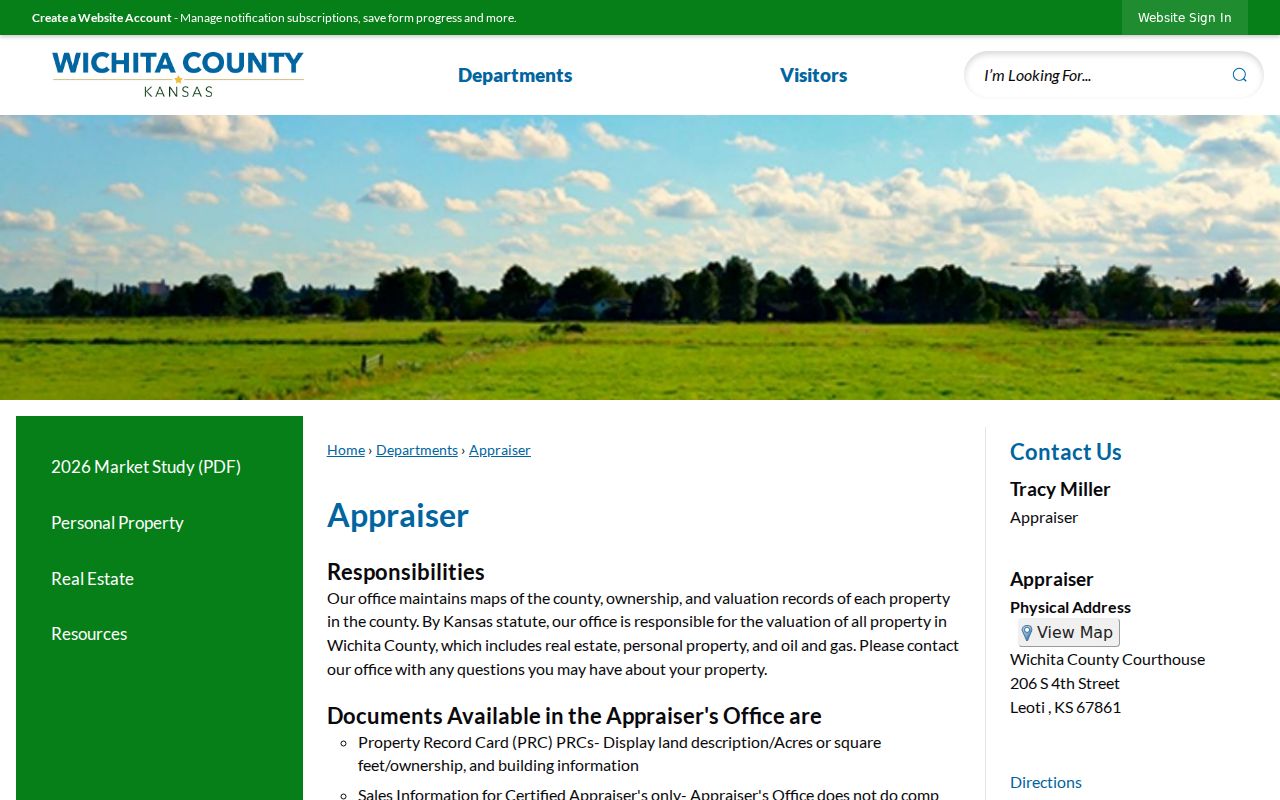
Use the public PRC fields as identifiers only. The card settles no title, boundary, or sale price.
Wichita County Deeds Stay Offline
The Register of Deeds records deeds, mortgages, releases, assignments, oil and gas leases, powers of attorney, plats, and other instruments. All of these affect real property. The office opens its records for public inspection during regular hours. However, it links no public grantor-grantee database. It also states no online coverage year. That gap matters. Frame the search as an office inspection or a targeted staff request, not a promised web lookup.
Supply the grantor or grantee name and instrument type. Include approximate recording dates, parcel identifier, and exact legal description. Ask for the instrument number or book and page. Also request the recording date, the parties, and copy options. Ordinary deeds and mortgages up to legal size cost $21 for the first page. Each later page costs $17. Copies run $1 per page. Certification adds $7.50. Confirm the current charge before ordering.
Three Wichita County Tax Roles
A Wichita County tax record crosses three offices. The Appraiser values and classifies the parcel. The County Clerk certifies levies. The Treasurer bills, collects, and distributes the tax. A correction bill can follow when value or classification changes after an original bill. For real estate, the county calendar sets January 1 as the assessment date, March 1 as the notice date, and May 20 as the final valuation date, subject to the actual notice and appeal procedure.
Real-estate taxes are due December 20, either in full or as the first half. The second half comes due May 10. After three years of unpaid real-estate taxes, the property can enter county tax foreclosure and public auction. Those milestones are different records, not a single status. Confirm the tax year and whether the question concerns a balance, publication, county purchase, auction, or post-sale deed.
Wichita County Property Record Types
Different records answer different questions. A deed proves a conveyance was recorded. A PRC connects an assessment account with land and building data. A tax statement reports a particular year's bill. A plat depicts a recorded subdivision layout. A court docket can show a foreclosure, quiet-title, partition, lien, or probate dispute. Leoti permits document proposed work and land-use review. Applicant or contractor names never establish ownership.
| Record Type | What It Documents | Kept By | Access |
|---|---|---|---|
| Deeds | Recorded ownership transfers and legal descriptions | Register of Deeds | Free office inspection; copies cost extra |
| Mortgages and liens | Recorded security interests, assignments, releases, and notices | Register of Deeds | Office request by party or parcel |
| Assessment and tax | Ownership field, land, buildings, value, classification, bill, and status | Appraiser and Treasurer | PRC and office request |
| Plats and parcel maps | Lot, block, addition, section, and map context | Register of Deeds and Appraiser | Recorded plat or requested map |
| Building and zoning | Proposed work, plot plans, conditional uses, and ordinances | City of Leoti | Forms, minutes, ordinances, or KORA request |
The Wichita County deed records guide covers deed chains and certified copies in full detail. Tax balances and appeals belong in the tax guide. Each record type answers a different question. Matching one legal description across the deed, tax roll, and plat is far more reliable than treating a shared name or mailing address as proof that two records concern the same parcel of land.
Wichita County Maps Have Limits
Wichita County maps have real limits. The Appraiser maintains maps but says plainly that the office holds no property-line information. Kansas ORKA documents a statewide mapping framework, though no county-specific public viewer exists for Wichita County. Leoti links to a GWorks mapping site. That service turns public visitors away with an access-denied screen. So treat map offerings cautiously. Do not expect parcel selection, owner cards, buffers, or downloads from any uninspected tool. Ask the office directly what it can supply. An assessment map, tax-map sketch, or recorded plat may be available on request. These records are not interchangeable. A plat shows the recorded arrangement of lots and blocks. A GIS display helps you locate land. Neither one places a disputed boundary on the ground. Compare the deed's legal description and any easements against the plat, then leave the boundary decision to a licensed surveyor.
Cowen's Addition Links Four Records
A 2024 newspaper foreclosure notice offers a concrete research key for one Leoti property. It lists Lot 2, Block 9, Cowen's Addition, parcel ID 01941, and the common address 503 S 5th Street. It also names District Court case WH-2023-CV-000005. A notice proves nothing about current ownership. It does not settle the case result either. Its real value is the set of exact strings you can carry to four offices. Take the address and parcel to the Appraiser. Ask the Register of Deeds for the plat and instruments by lot, block, and addition. The Treasurer can match the parcel to the tax roll. For the court side, search the case number in Kansas CaseSearch. Then confirm the docket with the 25th Judicial District clerk. The statewide screen is not the official record. One Wichita County property can carry an address, a parcel ID, and a platted description. It can also carry a court number all at once.
Wichita County Court Record Leads
Court filings surface in many Wichita County property disputes. Foreclosures, lis pendens, mechanic's liens, quiet title, partition, boundary and easement cases, probate transfers, judgment liens, and sheriff-sale confirmations all leave a docket trail. Kansas CaseSearch takes a court, search type, required term, case type, date of birth, and file-date range. Older documents and some case types are missing. Search by name and case number when you have one. The Wichita County District Court sits in the 25th Judicial District at 206 South 4th Street, P.O. Box 968, Leoti. Public-access computers sit in the law library. Use the sign-in sheet there. Requests go through by phone, in person, in writing, or by fax. Copies run $0.25 per page. A portal hit is only a lead. Always pull the docket or filed document before drawing any conclusion about a lien, sale, or title.
From Bonasa to Leoti Records
A failed modern-address search sometimes needs an older name. Kansas Historical Society records show the Bonasa post office opened January 7, 1886. It became Leoti on February 19, 1887. Coronado operated from 1886 to 1899. Lydia, tied to Kearny as well, ran from 1888 to 1928. Selkirk, Carwood, and Marienthal appear in other periods. These were postal or historical places, not proven present-day cities. Search the old place name alongside the legal land description. KSHS land-record guidance points to tract books, original surveys, and railroad grants. It also points to county deeds, plat atlases, and federal patent sources. Tract books are organized by section, township, and range, not by owner name. Newspapers and local historical society maps can help. The 506-page Wichita County History Volume II index can pin down a person or place. Title still requires the deed trail.
Leoti Permits Add Property Context
Leoti City Hall holds municipal records the county property offices do not. Its building and mobile-home permit form asks for the property location, owner, legal description by block, lot, and addition, work dates, dimensions, estimated cost, contractor, project category, use, and materials. The plot plan must show streets, measurements, utilities, and north. Work cannot start before approval. The permit lasts 180 days after approval. The listed fee is $25. The contractor must hold a city license on file. Those fields can tie construction history to a parcel. Still, a permit is not a deed, appraisal, or survey. Leoti's official forms page also lists a conditional-use application. Its direct PDF link is not publicly reachable, though. Ordinance indexes hold 2024 zoning-change and 2022 planning, zoning, and land-bank leads. Request the application, notice, minutes, recommendation, final action, and any map or description from City Hall. Do not infer a result from an index title.
KORA Requests for Property Records
When a Wichita County property record is not posted anywhere, the Kansas Open Records Act, K.S.A. 45-215 through 45-223, still gives you a path. The county accepts requests by mail, email, or fax. Describe the record specifically. Most requests draw a response within three business days. A complicated map, an old deed book, or a record still under review can take longer. When that happens, the office may send a written explanation of the delay or denial instead.
Fees can apply. An agency may charge for staff time and reproduction, sometimes in advance. K.S.A. 45-230 also restricts public lists of names and addresses used to sell property or services. Ask for a parcel-specific record rather than a bulk resident list. Leoti keeps a separate form listing $0.25 per page and $10 per staff hour. Those are city charges. They are not the county recorder's fee schedule.
A strong request names the custodian, the record, the parcel, and the date range in plain language. For an assessment question, list the PRC fields you need and the assessment year. For a deed question, include the known parties, the instrument type, and the legal description. City matters take more care. Request the permit, the agenda packet, the minutes, the recommendation, and the final action as separate items. A discussion item can look like an approved ordinance. A blank application is not completed work.
The County Clerk serves as Wichita County's KORA contact and secretary to the Board of County Commissioners. That office can route a general request. It cannot stand in for the Register of Deeds, the Appraiser, the Treasurer, or the courts as custodians of their own records. Older or complex material may require staff research and copying charges. Ask for an estimate before authorizing extensive work. Request a written explanation if access is delayed or denied.
Limits of Wichita County Property Records
Wichita County property records can tell you a great deal: the PRC ownership field, assessed facts, tax-year status, deeds, mortgages, releases, liens, plats, permits, and court activity. They are not perfect. Records may be incomplete, delayed, corrected, or scattered among several custodians. The Sales Validation Questionnaire and military discharges are closed to recorder inspection, Appraiser sales information is limited, and Safe at Home may substitute a protected residential address. A missing address is not proof that a record is false.
Read each document for what it actually is. A recorded deed does not guarantee clear title. A map line does not establish a surveyed boundary. An assessed value is not a sale appraisal, and a court search result does not prove the final disposition. Confirm the date, legal description, instrument, office, and record status that control your specific question.
Lawful use. Wichita County property records support purchase research, title and estate work, boundary questions, tax review, and civic transparency. Never use an owner's information to stalk, harass, threaten, or bypass a protected address.