
Read Wichita County Property Tax Records by Office
Three offices split Wichita County property tax records, and knowing the split saves time. The Appraiser determines valuation and maintains the Property Record Cards. The Clerk certifies levies. It also processes corrections alongside the Appraiser. The office keeps county budget and levy context. The Treasurer then collects real-estate and personal-property tax. It passes the money to the taxing units. Confirm this office division before requesting any record.
| Record item | Question it answers | Wichita County source |
|---|---|---|
| Appraised value | What market-value estimate was placed on the parcel? | Appraiser and PRC |
| Assessed value | What class-adjusted amount receives the levy? | Appraiser |
| Levy | What certified rate applies to the tax base? | County Clerk |
| Bill and payment status | What is due, paid, corrected, or delinquent? | Treasurer |
| Correction record | Did the Appraiser and Clerk change the original bill? | Appraiser, Clerk, Treasurer |
Kansas turns appraised value into a tax bill in two steps. A constitutional class rate produces assessed value, and the levy is applied to that figure. Residential property sits at 11.5 percent. Vacant lots carry 12 percent. Agricultural land is assessed at 30 percent of its use value. Agricultural improvements are assessed at 25 percent. Commercial and industrial property also falls at 25 percent. Classification matters in Wichita County. Farmland and a farm residence can be treated quite differently.
Follow Wichita County Property Tax Value Dates
Wichita County's tax year opens on January 1. That is the assessment date, and new construction is valued as of that same day. Kansas guidance then moves the calendar through several stages. A March notice period comes next. It is followed by a 30-day equalization appeal window counted from the date the notice was mailed. Owners can request an informal meeting by May 15. The Appraiser's final determination arrives by May 20. The county Appraiser page adds one more marker: change-of-value notices are due by March 31. The appeal clock runs from the mailing date. Keep the actual notice rather than relying on memory.
Oil and gas holdings follow a different schedule. So does personal property. A real-estate calendar cannot simply be applied to those records without checking the county notice. The sequence also splits responsibility cleanly. An early-year question about a value belongs with the Appraiser. A payment question later in the year belongs with the Treasurer.
Request Wichita County Property Tax Records
Wichita County publishes no online public tax-query screen. The dependable route to Wichita County property tax records is an office request built on enough parcel detail to separate similar names and years. The Treasurer sits at 206 South 4th Street, P.O. Box 488, Leoti, KS 67861, takes calls at 620-375-2715, and keeps weekday hours of 8 a.m. to noon and 1 to 4:30 p.m. Call ahead to confirm the details before making the trip.
- Give the Treasurer the situs address, legal description, parcel ID if known, and exact tax year.
- Ask for the bill status, paid or unpaid status, and correction history if that material is public.
- Request any public tax-sale notice separately; a delinquent account does not by itself settle title.
- Compare the bill with the Appraiser's PRC and the value notice for the same assessment year.
- Appraised value
- The county's market-value estimate before the property class rate is applied.
- Assessed value
- The class-adjusted tax base to which the levy is applied.
- Levy
- The certified rate used with assessed value to calculate tax.
- Tax lien
- A public claim tied to unpaid tax, distinct from proof of present ownership.
Track Wichita County Property Tax Payment Dates
Wichita County mails tax statements after November 1 and before December 15. Taxes stay due even if a statement never arrives. December 20 is the deadline for a full payment or the first half. May 10 closes the second half. Those dates make the Treasurer's paid or unpaid record more dependable. No guess about the mail can match it.
Start with the official Treasurer page at Wichita County Treasurer. Then call if the published guidance cannot resolve a parcel, year, or corrected amount. Ask when a payment posted, not merely whether a check was sent. The county's official office page displays the Treasurer's published payment information.
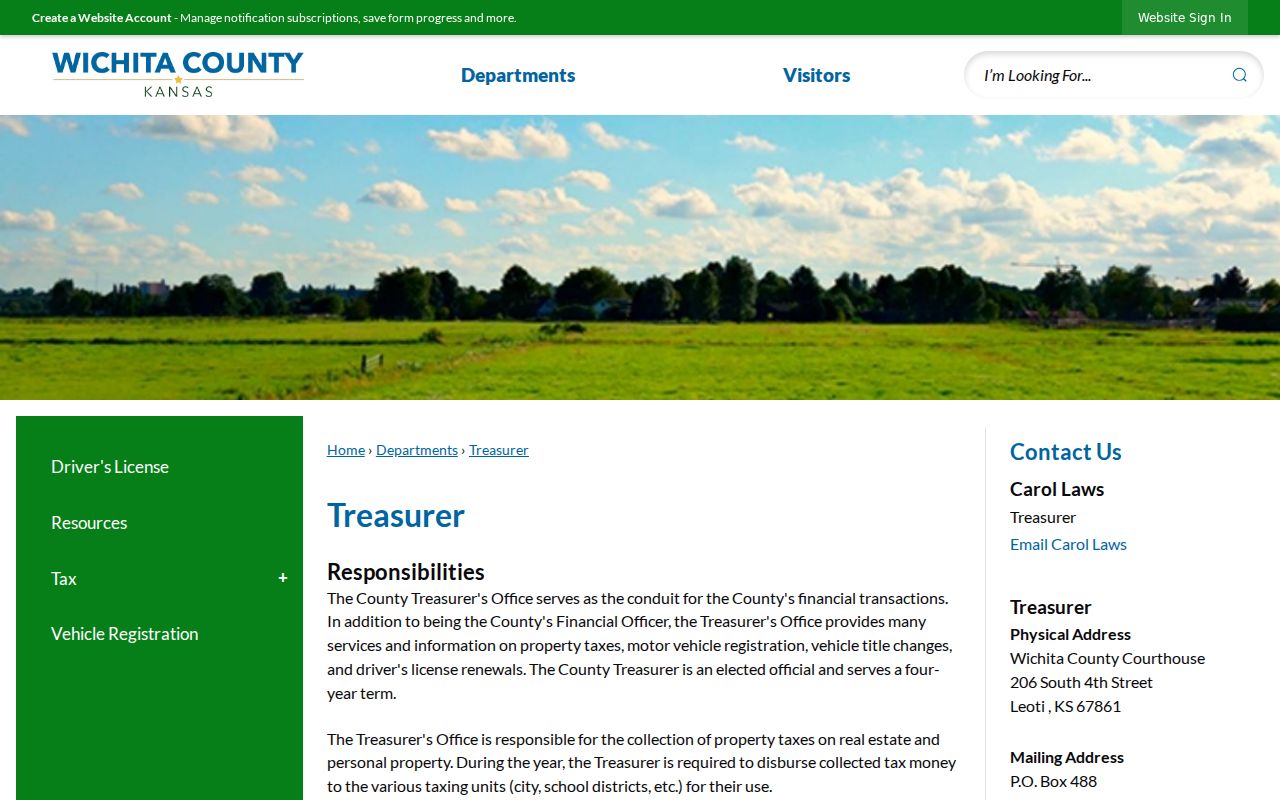
The image shows the official office route for a tax-bill question in a county without a public parcel-query screen.
Understand Corrected Wichita County Property Tax Records
A Wichita County property tax record can change after the first bill goes out. County guidance assigns the work across offices. The Appraiser and Clerk issue corrections, and the Commissioners approve them. The Treasurer then mails the corrected bill. If the first half is unpaid, a reduction can show up in the second-half statement. If the full bill was already paid, the change may produce a refund.
Always request the correction itself. Compare its tax year, parcel identity, and value against the original statement. A new balance alone cannot tell you the source. It may have been classification, description, a physical change, or another adjustment. The official Wichita County tax guidance lays out this cross-office route.
Put Wichita County Property Tax Trends in Context
The county's 2025 Market Study reports a positive 4 percent residential trend. It calls the residential market fairly steady. Dryland and irrigated agricultural values show a moderate decrease. The study drew on valid arms-length sales from 2020 through November 2024. It still let an individual parcel value move for physical changes, description corrections, or calibration against similar sales.
This is countywide context, not a parcel calculator. A residential trend tells you nothing about agricultural use value. Neither trend proves the worth of one Leoti lot or one farm. The split matters most where land and improvements fall into different Kansas property classes.
Inspect Wichita County Property Tax Appraisal Sources
The county's Appraiser page explains what Property Record Cards can contain: land description, acreage or square feet, ownership, and building information. No live public parcel form is provided. The page also says sales information is limited to certified appraisers, and the office does not provide property-line information.
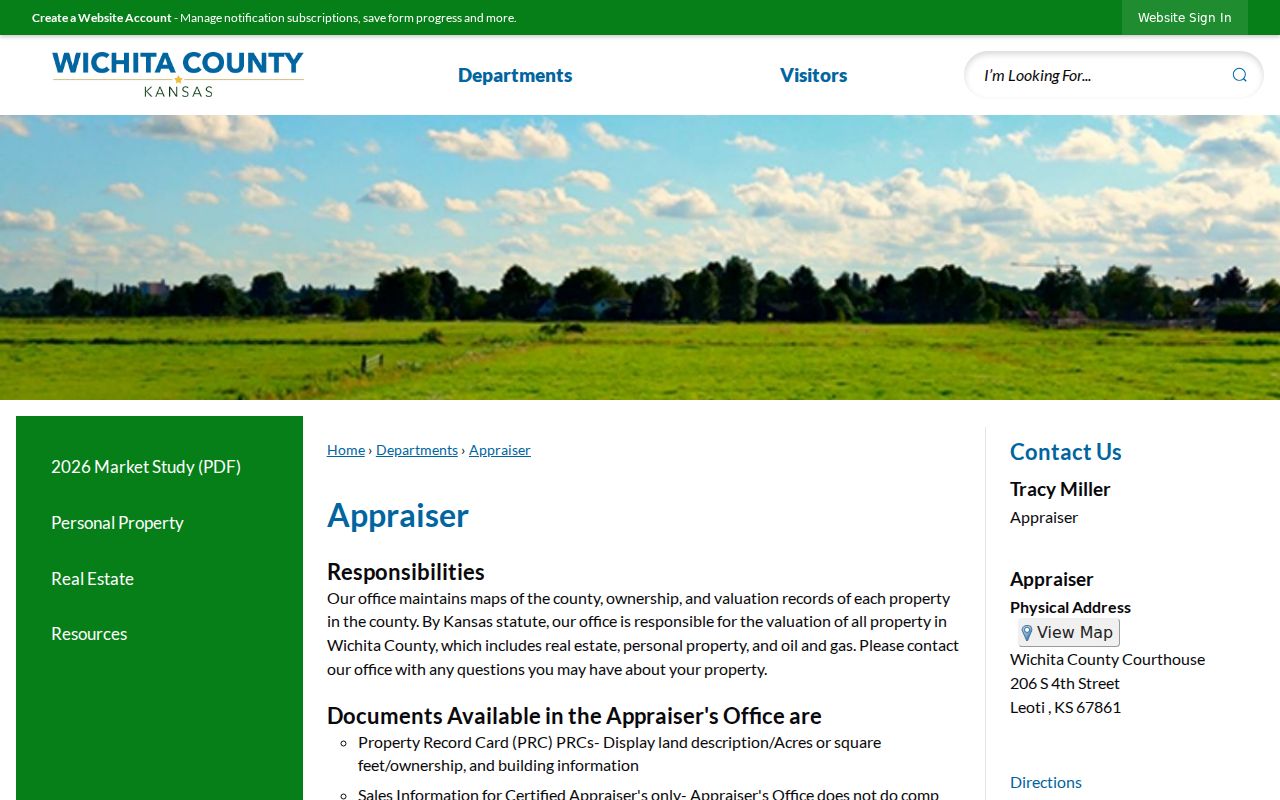
The county's own assessment pages point to an office-first request for appraisal questions. A PRC, a deed, and a survey each answer different questions. The county records make those distinctions clear. Tracy Miller's Appraiser office is at the courthouse, P.O. Box 591. It lists 620-375-4242 with weekday hours of 8 a.m. to noon and 1 to 5 p.m.
Separate Wichita County Property Tax Delinquency From Foreclosure
Delinquency unfolds in stages. A missed payment comes first. Then a lien attaches. A notice gets published. Only later does a completed tax foreclosure occur.
Ask the Treasurer for the public account status and any pending tax-sale notice. If litigation is claimed, check with the Wichita County District Court. Kansas CaseSearch is a lead rather than the official file. The local clerk can supply the docket or named documents by phone, in writing, by fax, or in person. Its public computer offers another way to get them.
A notice alone never proves who the current owner is. A court result and a later recorded deed can be separate events. The Register of Deeds keeps its records open for public inspection during regular business hours. That access makes the office the final instrument check after any court process concludes.
Contest a Wichita County Property Tax Value
An equalization appeal targets the Appraiser's value. The Treasurer's arithmetic applies after the value and levy are set. That math is not on the table.
Kansas and county guidance give the taxpayer 30 days to appeal. The clock runs from the mailing of the notice. An informal meeting follows, then a determination under the state calendar. Keep the envelope, the notice, and the PRC. Keep photos of the property's physical condition. Also keep any legal-description or building-data correction that supports the request.
The county page and the state calendar do not share one shorthand date for every notice. The deadline printed on the actual mailed notice is the one that governs. Contact the Appraiser promptly. The Board of Appeals route opens after the agency determination. For the distinct meaning of the value figures, see the Wichita County property value guide.
Appeal window. Retain the mailed notice and act within its stated period; county and Kansas guidance describes a 30-day equalization appeal window.