
Compare Wichita County Property Value Types
Kansas law demands precise labels. Appraised value is the county's estimate of market value for most property. Assessed value multiplies that figure by the class rate. That class rate is set in the constitution for the property's category. Farmland moves through a use-value method instead. That method is built on income rather than market sales. So its figure cannot be read like a residential estimate.
| Value type | Meaning | Record source |
|---|---|---|
| Appraised value | County estimate of market value for the valuation date | Appraiser and PRC |
| Assessed value | Appraised value after the Kansas property class rate | Appraiser |
| Agricultural use value | Economic or use-based land value, not direct market price | Appraiser under Kansas guidance |
| Sale consideration | Amount reported for a transfer, subject to transaction facts | Deed and validation workflow |
One parcel can hold several valid numbers at once. The assessed figure exists to support taxation. The sale amount only describes a single transfer, and neither number standing alone tells you what a buyer would pay today.
Apply Kansas Class Rates to Wichita County Property Values
State educational material sets the class rates. Residential property is assessed at 11.5 percent of appraised value. Vacant lots sit at 12 percent. Agricultural land uses 30 percent of its economic or use value. Agricultural improvements use 25 percent, and commercial or industrial property also uses 25 percent, with other classes varying. The ratio yields the assessed value. But it says nothing about what a parcel could fetch on the open market.
A farm residence follows residential rules. The land beneath it uses the use-value approach, and improvements can carry their own class. Wichita County includes substantial dryland and irrigated acreage. Applying a single ratio across a whole mixed-use parcel invites error.
Request Wichita County Property Value Records
Wichita County publishes no online property-search portal of its own. That makes a written PRC request the dependable route. Send it to the Wichita County Appraiser, and include the land identifiers the office can match, such as a parcel number or the owner of record. Precision matters here. The Appraiser sits at 206 South 4th Street, P.O. Box 591, Leoti, KS 67861, phone 620-375-4242, open weekdays from 8 a.m. to noon and 1 to 5 p.m.
- Give the situs address plus parcel ID and legal description when known.
- Request the PRC for a named assessment year and ask for appraised and assessed figures.
- Confirm the property class and whether land and improvements are treated separately.
- Record the valuation date and any later description or physical-property correction.
- Check a transfer amount separately and note why it may not be an arms-length sale.
- Appraised value
- The county's value estimate for the valuation date.
- Assessed value
- The class-adjusted amount used as the tax base.
- Assessment ratio
- The class percentage connecting appraised and assessed figures.
- Reassessment
- A later valuation cycle or correction that may change the record.
Date Wichita County Property Values Correctly
The Wichita County sequence begins with the January 1 assessment date. County and Kansas guidance describes a March notice, 30 days from mailing for an equalization appeal, an informal meeting by May 15, and final determination by May 20. The county Appraiser page separately says change-of-value notices are due by March 31, so the actual mailed notice and its date should be retained.
A figure without its year is incomplete. New construction is valued January 1, while oil and gas and personal property have different dates. A later tax statement may reflect the result, but the statement is not the source for interpreting how the Appraiser built the value.
Read Wichita County Property Value Trends Carefully
The official 2025 Market Study reports a positive 4 percent residential trend and a fairly steady market. Agricultural values tell a different story. The study shows a moderate decrease for both dryland and irrigated land. It rests on valid arms-length sales from 2020 through November 2024, and it notes that an individual value can shift for description corrections, physical changes, or calibration against similar sales.
That split blocks the common mistake of applying one headline trend to every parcel in the county. The study is countywide context. It is not a Leoti-only series. And it estimates nothing for one residence or farm.
Compare Wichita County Property Value and Sale Data
Kansas requires a Sales Validation Questionnaire with most deeds. The form is detailed. It captures sale price, deed date, seller and buyer, legal description, financing, personal property, improvements, and property use. It also covers a long list of non-arms-length factors. Its instructions define deed date as the signed date, not the recording date. County guidance keeps completed questionnaires out of public inspection. It limits sales information to certified appraisers.
Deed consideration carries its own traps. The stated amount may reflect a family transfer, partial interest, correction, or gift. It may also reflect a sheriff deed, trust movement, or debt security. Some transactions are exempt or otherwise special. That is why a sale figure sitting beside a conveyance should not be treated as a clean comparable.
Use Wichita County's Official Property Value Source
The Wichita County Appraiser page confirms the office maintains valuation records, maps, ownership, and Property Record Cards. A card can list land description, acreage or square feet, ownership, and building details. The office gives out no property-line information.
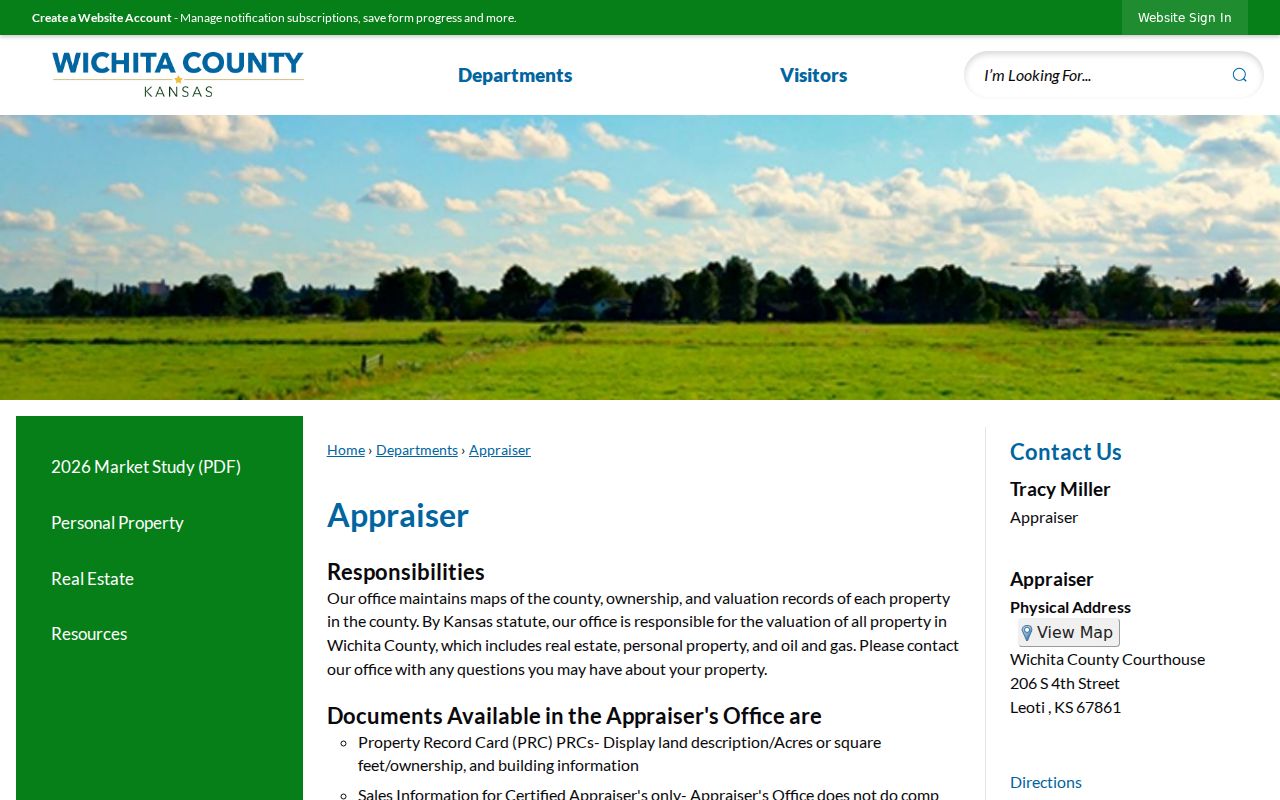
The county page supports an office request. It does not amount to an online parcel database. Those same limits keep a value request from drifting into a boundary opinion or an unsupported sales comparison.
Interpret Wichita County Agricultural Property Value
Kansas agricultural guidance leans on soil, productivity, and capitalized-income concepts. It describes a landlord net-income and capitalization-rate framework plus an eight-year average. Use value answers a statutory valuation question. It will not predict an open-sale price.
Improvements on agricultural land follow the applicable improvement class. A farm residence gets residential treatment. When reviewing Wichita County property values, ask for the land and improvement components, and their classes, before making any comparison.
Know What Wichita County Assessed Value Cannot Prove
An assessed value answers one narrow question. It sets the tax base, nothing more. The number will not prove what a property sold for. It will not show where the boundary lines fall. It cannot say what condition a building is in right now. The Appraiser says so directly, disclaiming property-line information and restricting sales data. Ownership can shift too. A recorded deed does not always change the value figure on the same day.
Corrections to a legal description or a physical change to the parcel can move one value. The countywide trend can still hold steady. To see how appraised value becomes assessed value, the official Kansas property valuation guide lays it out plainly. Bills, payments, corrections, and appeals belong in a different process. That process is covered in the Wichita County property tax records guide.
Value is not price. Wichita County assessed value supports taxation; it is neither a sale forecast nor an independent appraisal of present market value.