
Trace Wichita County Former Owners by Era
Start with the newest deed reference you have. Reach for older sources only as needed. Wichita County publishes no starting year for its online deed index, so the era table leaves date columns blank instead of guessing.
| Source | Years It Covers | Where Held | What It Shows |
|---|---|---|---|
| Recorded deed references | Coverage not published online | Wichita County Register of Deeds | Named grantors, grantees, descriptions, and recording sequence |
| Older deed books | Ask office by legal description and period | Register of Deeds | Earlier conveyances beyond available modern references |
| Plats and plat atlases | Varies by addition or survey | Recorder and Kansas Historical Society | Subdivision, lot, block, and land layout |
| Tract books and patents | Original public-land transfers | Kansas Historical Society and federal resources | First purchasers or grantees by section-township-range |
Public inspection happens at the Register of Deeds during regular business hours. Modern chains start there. Original-title questions need a different route. Begin with the current legal description and work toward state tract-book and survey resources, rather than chasing an old owner's name through every collection.
Prepare a Backward-Chain Request Packet
Give the recorder a precise request. Name the exact instrument sought. Include the known grantor and grantee, the legal description, the parcel ID, and a focused date range. Ask for the book and page or instrument number. The office is at 206 South 4th Street, P.O. Box 472, Leoti, KS 67861; call 620-375-2733 or email whcorod@wichitacounty.org. Public inspection hours are weekdays, 8 a.m. to noon and 1 to 5 p.m. No online grantor-grantee search screen exists. Staff-assisted inspection is the documented channel, not a last resort, and staff can say whether an older deed book can be inspected; review the Wichita County deed custodian page for contact details.
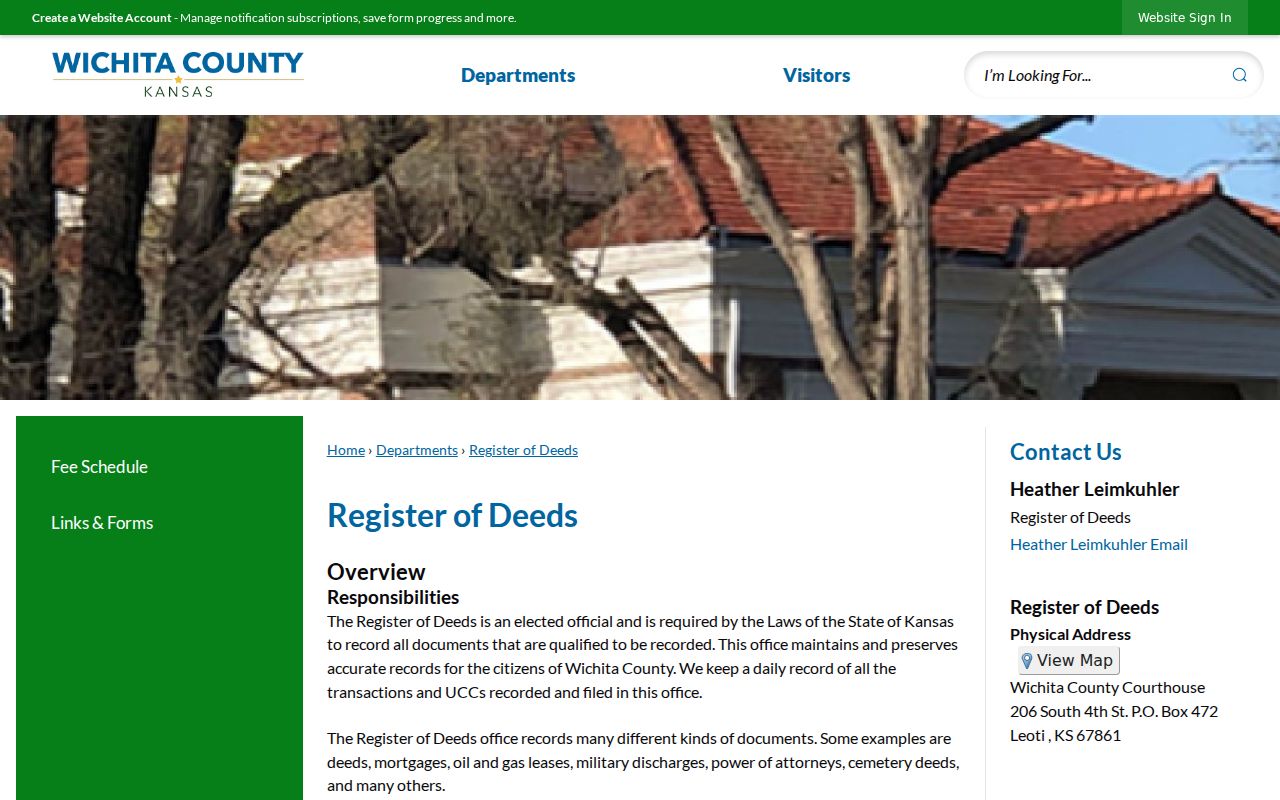
That county page anchors the search in county-held records.
Walk the Wichita County Chain Backward
Backward research flips the usual forward transfer view. Treat the current acquiring instrument only as an anchor. Its grantor becomes the prior owner, and your next job is locating the deed by which that grantor earlier received the same land.
- Copy the current legal description exactly from a reliable county record.
- Identify a matching deed and record the transfer date, grantor, grantee, type, and book/page or instrument reference.
- Treat that grantor as the next earlier grantee to search.
- Repeat only when the legal description continues to match; then move to older deed books when modern references end.
- Grantor and grantee
- The parties conveying and receiving the stated interest.
- Chain of title
- The ordered instrument trail associated with the same land.
- Reverse index
- A grantor-oriented route used to trace outgoing transfers.
- Warranty and quitclaim deeds
- Different conveyance forms whose legal effect cannot be inferred from the label alone.
Anchor the Timeline With Cowen's Addition
A 2024 foreclosure notice supplies one concrete description. It names 503 S 5th St, parcel ID 01941, Lot 2, Block 9, Cowen's Addition to the City of Leoti. By itself it proves no ownership. Use that wording to request deeds and the plat. The litigation lead sits in case WH-2023-CV-000005 on Kansas Courts CaseSearch.
| Transfer Date | Grantor to Grantee | Instrument | Reference |
|---|---|---|---|
| Newest verified date | Copy exact names from deed | Copy recorded type | Book/page or instrument number |
| Previous matching date | Earlier grantor to later grantor | Copy recorded type | Older matching reference |
| Continue backward | Repeat by legal description | Note corrections or probate links | Deed book, plat, or court file |
This is a worksheet pattern, not a claim about the unnamed parties to the Cowen's Addition parcel. Treat it as one step in a Wichita County property records search.
Historic Postal Names Can Hide Previous Owners
Bonasa became Leoti in 1887. County post-office history also includes Coronado, Lydia or Kearny, Carwood, Marienthal, and Selkirk. An early deed, newspaper notice, estate paper, or tax reference may carry one of those old place names instead of a current mailing address. The KSHS Wichita County post-office search lists 22 records. Add both names to requests. Keep the legal description as the controlling land clue in every newspaper and archive search.
Tract Books Identify First Purchasers, Not Owner Lists
The KSHS land-record guide catalogs Kansas Tract Books, railroad grants, original surveys, county deeds, plats, and federal patent resources. Tract books are rich but narrow. A page can show section-township-range, purchaser or grantee, acreage, price information, sale date, and governing law. Nothing is indexed by owner name. Convert the description to section, township, and range first. Record any patent or grant number. Move forward through county deed books from there; a patent marks an original federal transfer, not a modern owner, so see the Kansas land-record collections before drawing conclusions.
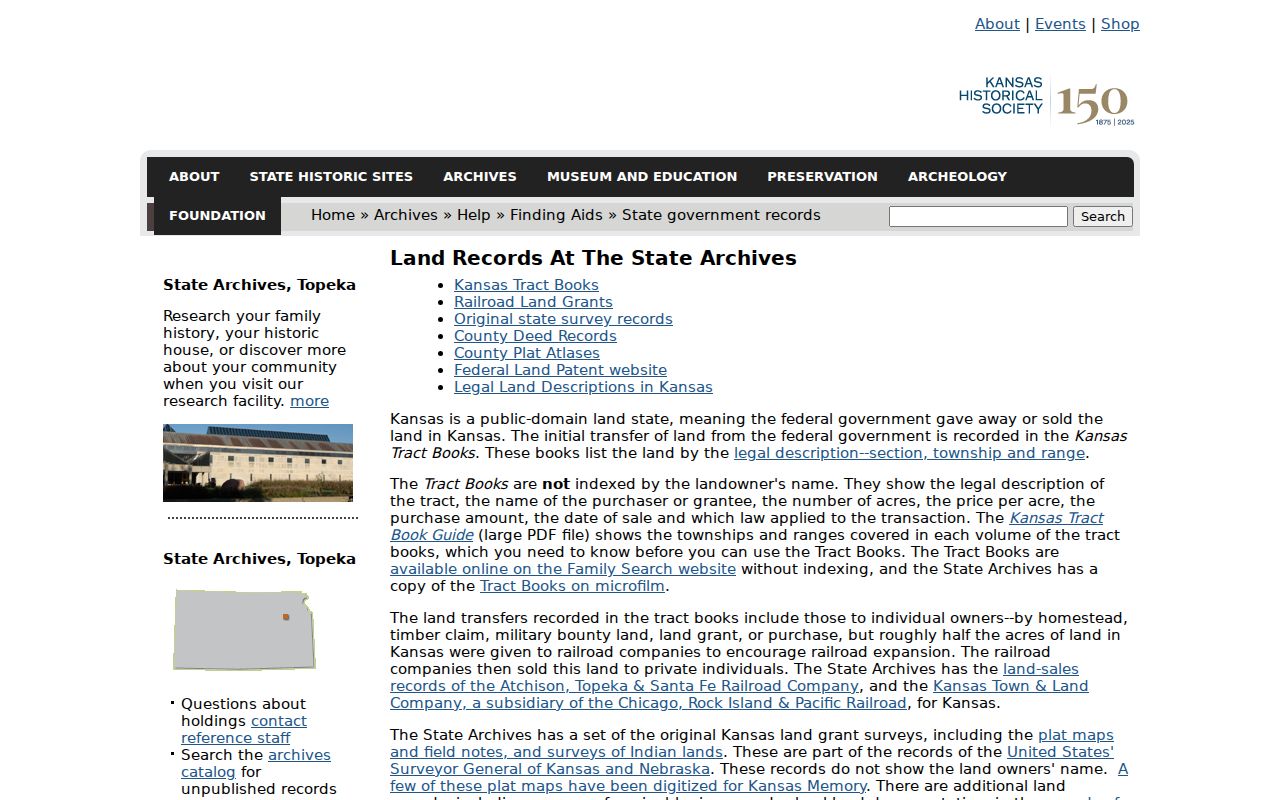
Legal descriptions, not name boxes, open the oldest layer.
Probate May Interrupt a Clean Deed Sequence
An owner can die before a later conveyance. When that happens, the deed chain depends on estate authority or a court order. Search the decedent's name in CaseSearch. Note the case number and filing gaps. Request the specific probate filing from the Wichita County District Court, then look for an executor or administrator deed, affidavit, transfer-on-death instrument, joint-tenancy survivorship record, or beneficiary deed. Compare everything across court and recorder records. The legal description, parcel ID, and recording date should all agree before you rely on the chain. Remember that a death certificate is not a freely searchable property record in Kansas, and a deed's existence does not make it public.
Newspapers Bridge Missing Name Clues
The Kansas newspaper database offers city, title, county, and date search fields. Feed it exact additions. Old post-office names, estate, deed, sheriff sale, tax sale, and county seat all make productive search terms too. Capture the issue date and page. Then return any named party to the recorder. KSHS reports that many Kansas newspapers from 1854 through 1922 are online for Kansas residents, and that residents can borrow microfilm through a local library. The Wichita County Historical Society at 201 N 4th in Leoti holds county maps, cemetery maps, old-town material, and a 506-page Volume II name and topic index. These are finding aids, not certified title evidence.
Know Where Wichita County Ownership Records Change Form
Wichita County dates to March 20, 1873. It was not organized until December 24, 1886. An 1886 organization file held by Kansas Memory records the proclamation that appointed officers. It also named Leoti as temporary county seat. Those dates anchor the earliest ownership research. The recorder publishes no stated first deed-book year or earliest online index date. Ask the custodian directly for both.
When county references run dry, older tools still pay off. Recorded plats, original surveys, tract books, and patents all help trace early parcels in Wichita County. Railroad-land records help too. Selkirk's tie to the Atchison, Topeka & Santa Fe Railway matters here. It makes railroad names useful search variants for land near that historic place. The county reports no courthouse fire or wholesale deed loss. Treat any gap as a question for the recorder rather than a lost record. No disaster explains it.
Lawful use. Former-owner research supports land history, estate work, and purchase diligence. Do not use names or addresses to track, threaten, or harass a living person.